
StatusCake

The Magic Number of SaaS – Calculating Your Target MRR

42 may be “The Almighty Answer to the Meaning of Life, the Universe, and Everything”; and according to De La Soul 3 may be the “Magic Number”; but when it comes to SaaS KPIs there’s only one number you need to keep at the front of your mind – 78.

78 is the magic number when it comes to SaaS, to predicting the MRR (monthly recurring revenue) you need to keep hitting month-in-month-out to reach your ARR (annual recurring revenue) goal for the next year.   Simply subtract your target ARR from your last year’s ARR and divide by 78.  It really is that simple.

So let’s give it a go.  Assume your target this year is $1m ARR and that last year you hit $610k ARR.  So what new MRR do you need to hit each month to reach your goal?

2016 ARR goal is: $1,000,000
2015 ARR was: $610,000
Jump in ARR for 2016: $390,000
Target MRR ($1,000,000 – $610,000) / 78


= $5,000 per month


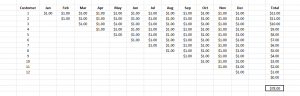
Still not convinced?  This is how it works.  And let’s make the numbers even simpler.  Let’s say you get 1 new customer each month who brings you in $1 per month.  We’ll also assume that they never churn.  The customer that signs up in January is worth $12 to you; the February customer $11 and so on right down to December’s customer who earns you $1.  And there you have it, $78!

Rule of 78 - Calculating MMR from your target ARR

Can’t be bothered to do the math?  Use our SaaS Rule of 78 Calculator below to work out your target MRR!

Last Years ARR
Your Target ARR
Your Target MRR is

It’s that simple.  Now getting selling!


Share this

More from StatusCake

AI Didn’t Kill the SDLC. It Made It Harder to See

10 min read Whilst AI has compressed the visible stages of software delivery; requirements, validation, review and release discipline have not disappeared. They have been pushed into automation, runtime and governance. The real risk is not that the lifecycle is dead, but that organisations start acting as if accountability died with it. There is a now-familiar story about

When Code Becomes Cheap: The New Reliability Constraint in Software Engineering

4 min read How AI Is Shifting Software Engineering’s Primary Constraint For most of the history of software engineering, the primary constraint was production. Code was expensive, skilled engineers were scarce, and shipping features required concentrated human effort. Velocity was limited by how fast people could reason, implement, test, and deploy. That constraint shaped everything from team size,

Buy vs Build in the Age of AI (Part 3)

5 min read Autonomous Code, Trust Boundaries, and Why Governance Now Matters More Than Ever In Part 1, we looked at how AI has reduced the cost of building monitoring tools. Then in Part 2, we explored the operational and economic burden of owning them. Now we need to talk about something deeper. Because the real shift isn’t

Buy vs Build in the Age of AI (Part 2)

6 min read The Real Cost of Owning Monitoring Isn’t Code — It’s Everything Else In Part 1, we explored how AI has dramatically reduced the cost of building monitoring tooling. That much is clear. You can scaffold uptime checks quickly, generate alert logic in minutes, and set-up dashboards faster than most teams used to schedule the kickoff

Buy vs Build in the Age of AI (Part 1)

5 min read AI Has Made Building Monitoring Easy. It Hasn’t Made Owning It Any Easier. A few months ago, I spoke to an engineering manager who proudly told me they had rebuilt their monitoring stack over a long weekend. They’d used AI to scaffold synthetic checks. They’d generated alert logic with dynamic thresholds. They’d then wired everything

Alerting Is a Socio-Technical System

3 min read In the previous posts, we’ve looked at how alert noise emerges from design decisions, why notification lists fail to create accountability, and why alerts only work when they’re designed around a clear outcome. Taken together, these ideas point to a broader conclusion. That alerting is not just a technical system, it’s a socio-technical one. Alerting

Want to know how much website downtime costs, and the impact it can have on your business?

Find out everything you need to know in our new uptime monitoring whitepaper 2021

*By providing your email address, you agree to our privacy policy and to receive marketing communications from StatusCake.