

StatusCake

New API Key Management function, and team access to data through the API and App

ssl monitoring

In this post, we’ll take you through the available options for managing sub-accounts, from managing permissions in app, to our new functionality which allows you to assign individual API keys to your users. First let’s take a look at our new API Key Management feature with support for multiple API Keys.

API Key Management

keyblog1

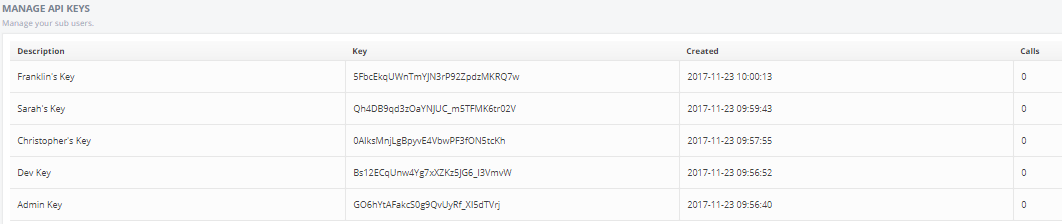
It’s now possible to add multiple API keys to an account, this means that for teams the same key will no longer need to be shared, and each member of staff/department can be assigned their own access token.

As well as being an improvement security wise, you can monitor the usage for each key in the API Key’s section of the user menu, to do this – and to add new keys for your team simply click here.

Sub-User Management

On our Business level plan it’s possible to add Sub-Users who have access to the in-app data, this allows them to view the information in a much more visual fashion when compared to the API. Sub-Users will be able to view the full settings and details of the tests on the “Main Account” depending on the permissions that they are assigned.

You can assign a few different parameters to your Sub-Users, first off you should decide whether they will have “view-only” or “full-edit” rights which will affect how they can interact with the test data from the main account.

Another handy option that can be set is tag based access, this means that you can assign a Sub-User to one or more test tags, and when they log in it’s only the tests under these tags that they will be able to see and interact with.

Share this

More from StatusCake

Monzo’s Stand-In Held Up on Wednesday. Some Customers Still Had a Bad Day.

3 min read On Wednesday 19 August, Monzo had an outage. DownDetector logged more than 3,000 reports by midday. Monzo’s own statement was direct about what it did next: it activated Monzo Stand-in, its fully independent backup bank, while it investigated an issue affecting customers. By the end of the day, Monzo said the issue was resolved and

What Broke GitHub on August 17 and How Retries Made the Incident Worse

3 min read GitHub’s incident on 17 August 2026 ran from 13:28 to 21:15 UTC, seven hours and forty-seven minutes. At peak, web and API traffic saw error rates of around 20%, while archive and raw-content downloads reached roughly 50%. SAML and OIDC authentication, SCIM and Team Sync were affected alongside Git operations, Actions, Pages, Issues, Pull Requests

Automate StatusCake Monitoring with viaSocket

3 min read Adding a new website, launching a customer portal, or handing a service to a new team should be straightforward. Setting up monitoring is part of that job, but it is easy for a manual step to be missed when information is spread across several systems. StatusCake now integrates with viaSocket, giving teams a way to connect

Website Monitoring Checklist: What to Track Beyond Uptime

7 min read A website may be standing and still be in trouble. It may answer a request, return a cheerful 200 OK, and yet load slowly enough that visitors begin to lose patience. Its certificate may be nearing expiry. Its domain records may have changed. A server may be filling its disk in the background, patient and

Blog

Beyond Uptime: Building a Self-Healing OpenClaw Observability Stack

3 min read The allure of OpenClaw is undeniable. You deploy a highly autonomous, self-hosted AI agent, give it access to your repositories and inboxes, and watch it reason through complex workflows while you sleep. It is the dream of the ultimate 10x developer tool realized. But as any veteran DevOps engineer will tell you: running an LLM-backed

Want to know how much website downtime costs, and the impact it can have on your business?

Find out everything you need to know in our new uptime monitoring whitepaper 2021

*By providing your email address, you agree to our privacy policy and to receive marketing communications from StatusCake.