Over the last few weeks we have been working hard to develop the next steps for our domain monitoring feature, and today you’ll see a range of new and advanced functionality implemented in-app.
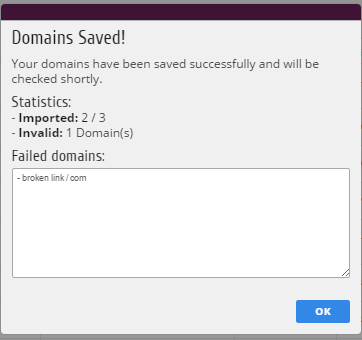
First off – we have added a completely new way to add the domains in-app, the system will guide you through a process with several steps, and will validate your entries at the point of submission, meaning a typo, duplicate or wrong setting will be picked up on right away – and you’ll be notified on any errors in the new submission summary window. The new submission system will also automatically detect the validity of the domain, if invalid it won’t be added to your list – saving valuable time.
Another improvement can be seen in terms of the number of TLD’s we now support, we are currently able to check over 250 different TLD’s , we provide an easy to access list in app too, so now when adding a domain you won’t be in for any unexpected results.
We have a brand new settings page for the domains which offer more configurable options in a cleaner layout. It’s now possible to set the start and expiry dates on this page – as well as enabling blacklist monitoring, domain expiration alerts, and record change notifications. By putting everything in one place and improving the layout we are hoping to improve a much smoother experience with reduced time spent on setup for each test.
We have also begun to pull through much more information regarding each Domain, you’ll now be able to see the full details concerning technical, administrative, and owner contacts from the WHOis on the details page for each domain.
A much requested feature that has also now been implemented is the option to run a forced re-crawl of Domain status and expiry, this can be very useful for occasions where you know that the data has been updated, and need to pull through the most recent info quickly. You can force crawl each domain once per 24 hours.
We’ve made it easy to guard against domain hijacking and be alerted quickly if it occurs! If an unauthorized entity manages to gain control over your domain in order to point it to a different website, we can alert you using our monitoring of the records – the moment we see an unexpected result you’ll be alerted by your chosen method.
As well as being able to force a re-check on the domain, we have now changed the way that the system crawls when we are close to expiry, instead of the standard 7-day crawl we will begin to check daily when expiry is near.
If you want to check out our new functionality for Domains and already have a paid account with us, these new tools and features will be available across all domains previously added, if you have yet to upgrade to a paid plan then now is the perfect time to come on board for this improved functionality.
4min read On 13th August 2026, a storm knocked out cooling at RadiusDC’s Phoenix data centre, which hosted essential Namecheap operations. To protect hardware from thermal damage, Namecheap took services offline while temporary chillers were brought in. The incident and recovery ran for roughly 30 hours, with Namecheap’s own site unreachable for about 11 hours 42 minutes
3min read On Wednesday 19 August, Monzo had an outage. DownDetector logged more than 3,000 reports by midday. Monzo’s own statement was direct about what it did next: it activated Monzo Stand-in, its fully independent backup bank, while it investigated an issue affecting customers. By the end of the day, Monzo said the issue was resolved and
3min read GitHub’s incident on 17 August 2026 ran from 13:28 to 21:15 UTC, seven hours and forty-seven minutes. At peak, web and API traffic saw error rates of around 20%, while archive and raw-content downloads reached roughly 50%. SAML and OIDC authentication, SCIM and Team Sync were affected alongside Git operations, Actions, Pages, Issues, Pull Requests
3min read Adding a new website, launching a customer portal, or handing a service to a new team should be straightforward. Setting up monitoring is part of that job, but it is easy for a manual step to be missed when information is spread across several systems. StatusCake now integrates with viaSocket, giving teams a way to connect
7min read A website may be standing and still be in trouble. It may answer a request, return a cheerful 200 OK, and yet load slowly enough that visitors begin to lose patience. Its certificate may be nearing expiry. Its domain records may have changed. A server may be filling its disk in the background, patient and
6min read StatusCake tells you that something might be broken. Hermes can check whether it really looks broken, decide who should hear about it, send the email, and keep the record for tomorrow morning’s summary.
Daniel
May 13, 2026
Sign up for the StatusCake newsletter
Want to know how much website downtime costs, and the impact it can have on your business?
Find out everything you need to know in our new uptime monitoring whitepaper 2021