


StatusCake

New Alert log feature, Bulk Update improvements, UI changes and API limit changes.

statuscake

We’ve got a few things to bring you up to speed with today, and you can find all the information below!

New Alert log feature

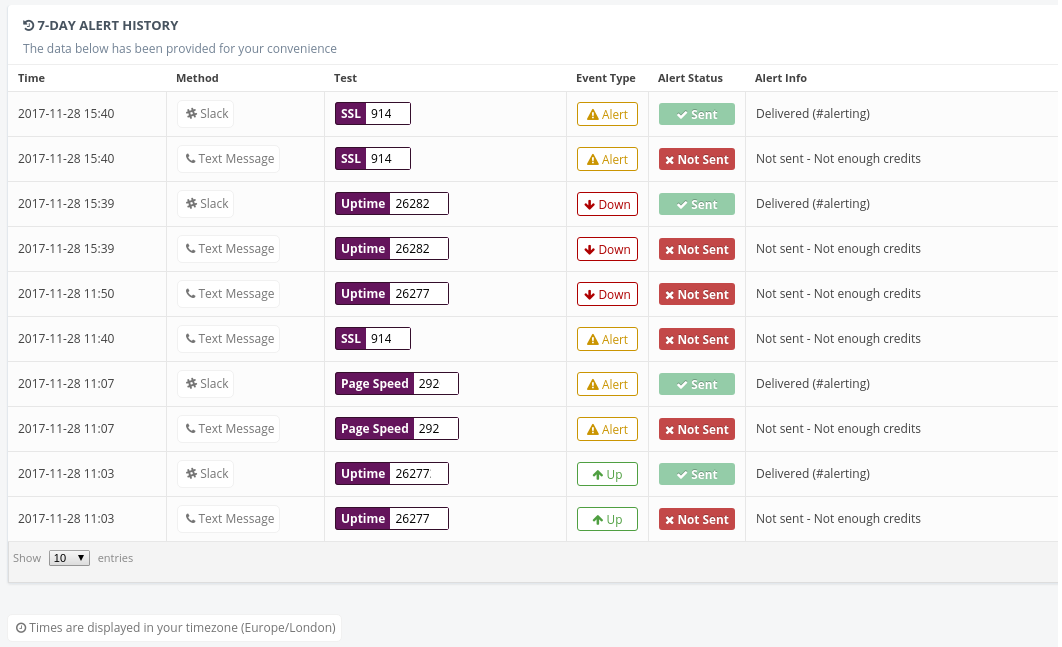
Our new Alert Log feature gives you a high level of visibility on alerts that have been sent out by our system, you can see the timing, and status of any alert we send no matter the alerting method.

newblog1

This new feature is available for all plans, so you can take advantage of the data whether you are on our free or Enterprise package! You’ll be given the reasons for any alert failures, some examples including running out of SMS credits and incorrect contact details. As well as a full log of all alerts sent out, with this tool you can also see logs of reports generated by features like Virus Scan.

You can access this new feature by going to the Contact Groups section of your account, and from here you can see the alert logs for each Contact Group on your account.

Bulk Update improvements

We’ve implemented a summary of which tests will be updated upon filtering for all Bulk Updates. This means that each time you run an update in bulk you’ll be able to see which tests were affected to the right side of the page.

blog1two

UI Improvements

First off we’ve made some improvements to the screen which displays all of your tests, primarily the changes are contained within the “Box View” layout, we’ve changed the buttons on the test boxes to be smaller and more accessible, and we’ve ensured that all of the options for each test can be easily accessed without needing to drill down into the test’s details.

We’ve also somewhat standardized the entry system for the email addresses in the Contact Groups to closely match the phone number entry section.

This means now that it will not be possible to miss alerts due to formatting errors, all previous phone numbers have of course been ported over to the new system already!

API Limit Changes

Following user requests, we’ve increased the burst limit for our API to 20 per second, up from 10. To accommodate this change and also to prevent abuse in future we have elected to have a daily limit of 100,000 API calls per account – this is a level at which we can see that very few users will be affected, and we feel that it’s a fair limit in terms of using our API on any paid plan. There are no changes to this on the free level plan, and the same limit of 250 calls per day will apply.

Share this

More from StatusCake

Engineering

Beyond Uptime: Building a Self-Healing OpenClaw Observability Stack

3 min read The allure of OpenClaw is undeniable. You deploy a highly autonomous, self-hosted AI agent, give it access to your repositories and inboxes, and watch it reason through complex workflows while you sleep. It is the dream of the ultimate 10x developer tool realized. But as any veteran DevOps engineer will tell you: running an LLM-backed

When AWS us-east-1 Fails, Much of the Internet Fails With It

7 min read There are cloud outages, and then there are us-east-1 outages. That distinction matters because failures in AWS’s Northern Virginia region rarely feel like ordinary regional incidents. They tend instead to expose something larger and more uncomfortable: too much of the modern internet still behaves as though one place is an acceptable concentration point for infrastructure,

In the Age of AI, Operational Memory Matters Most During Incidents

7 min read Artificial intelligence is making software easier to produce. That much is already obvious. Code that once took hours to scaffold can now be drafted in minutes. Boilerplate, integration logic, tests, refactors and small internal tools can be generated with startling speed. In some cases, even substantial pieces of implementation can be assembled quickly enough to

AI Didn’t Kill the SDLC. It Made It Harder to See

10 min read Whilst AI has compressed the visible stages of software delivery; requirements, validation, review and release discipline have not disappeared. They have been pushed into automation, runtime and governance. The real risk is not that the lifecycle is dead, but that organisations start acting as if accountability died with it. There is a now-familiar story about

When Code Becomes Cheap: The New Reliability Constraint in Software Engineering

4 min read How AI Is Shifting Software Engineering’s Primary Constraint For most of the history of software engineering, the primary constraint was production. Code was expensive, skilled engineers were scarce, and shipping features required concentrated human effort. Velocity was limited by how fast people could reason, implement, test, and deploy. That constraint shaped everything from team size,

Buy vs Build in the Age of AI (Part 3)

5 min read Autonomous Code, Trust Boundaries, and Why Governance Now Matters More Than Ever In Part 1, we looked at how AI has reduced the cost of building monitoring tools. Then in Part 2, we explored the operational and economic burden of owning them. Now we need to talk about something deeper. Because the real shift isn’t

Want to know how much website downtime costs, and the impact it can have on your business?

Find out everything you need to know in our new uptime monitoring whitepaper 2021

*By providing your email address, you agree to our privacy policy and to receive marketing communications from StatusCake.