

Want to know how much website downtime costs, and the impact it can have on your business?
Find out everything you need to know in our new uptime monitoring whitepaper 2021
4 min read On 13th August 2026, a storm knocked out cooling at RadiusDC’s Phoenix data centre, which hosted essential Namecheap operations. To protect hardware from thermal damage, Namecheap took services offline while temporary chillers were brought in. The incident and recovery ran for roughly 30 hours, with Namecheap’s own site unreachable for about 11 hours 42 minutes
3 min read On Wednesday 19 August, Monzo had an outage. DownDetector logged more than 3,000 reports by midday. Monzo’s own statement was direct about what it did next: it activated Monzo Stand-in, its fully independent backup bank, while it investigated an issue affecting customers. By the end of the day, Monzo said the issue was resolved and
3 min read GitHub’s incident on 17 August 2026 ran from 13:28 to 21:15 UTC, seven hours and forty-seven minutes. At peak, web and API traffic saw error rates of around 20%, while archive and raw-content downloads reached roughly 50%. SAML and OIDC authentication, SCIM and Team Sync were affected alongside Git operations, Actions, Pages, Issues, Pull Requests
7 min read A website may be standing and still be in trouble. It may answer a request, return a cheerful 200 OK, and yet load slowly enough that visitors begin to lose patience. Its certificate may be nearing expiry. Its domain records may have changed. A server may be filling its disk in the background, patient and
6 min read StatusCake tells you that something might be broken. Hermes can check whether it really looks broken, decide who should hear about it, send the email, and keep the record for tomorrow morning’s summary.
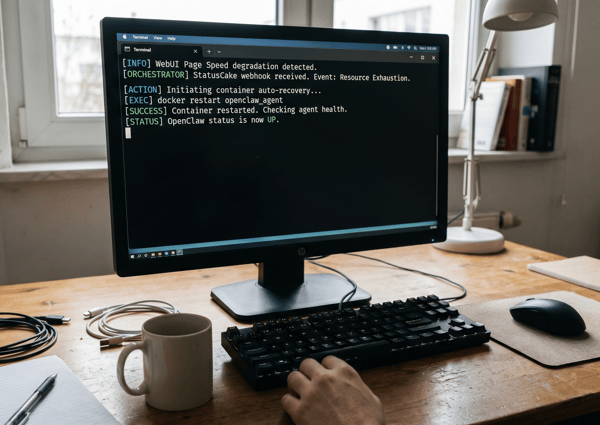
3 min read The allure of OpenClaw is undeniable. You deploy a highly autonomous, self-hosted AI agent, give it access to your repositories and inboxes, and watch it reason through complex workflows while you sleep. It is the dream of the ultimate 10x developer tool realized. But as any veteran DevOps engineer will tell you: running an LLM-backed
7 min read There are cloud outages, and then there are us-east-1 outages. That distinction matters because failures in AWS’s Northern Virginia region rarely feel like ordinary regional incidents. They tend instead to expose something larger and more uncomfortable: too much of the modern internet still behaves as though one place is an acceptable concentration point for infrastructure,
7 min read Artificial intelligence is making software easier to produce. That much is already obvious. Code that once took hours to scaffold can now be drafted in minutes. Boilerplate, integration logic, tests, refactors and small internal tools can be generated with startling speed. In some cases, even substantial pieces of implementation can be assembled quickly enough to
10 min read Whilst AI has compressed the visible stages of software delivery; requirements, validation, review and release discipline have not disappeared. They have been pushed into automation, runtime and governance. The real risk is not that the lifecycle is dead, but that organisations start acting as if accountability died with it. There is a now-familiar story about
4 min read How AI Is Shifting Software Engineering’s Primary Constraint For most of the history of software engineering, the primary constraint was production. Code was expensive, skilled engineers were scarce, and shipping features required concentrated human effort. Velocity was limited by how fast people could reason, implement, test, and deploy. That constraint shaped everything from team size,
5 min read Autonomous Code, Trust Boundaries, and Why Governance Now Matters More Than Ever In Part 1, we looked at how AI has reduced the cost of building monitoring tools. Then in Part 2, we explored the operational and economic burden of owning them. Now we need to talk about something deeper. Because the real shift isn’t
6 min read The Real Cost of Owning Monitoring Isn’t Code — It’s Everything Else In Part 1, we explored how AI has dramatically reduced the cost of building monitoring tooling. That much is clear. You can scaffold uptime checks quickly, generate alert logic in minutes, and set-up dashboards faster than most teams used to schedule the kickoff
5 min read AI Has Made Building Monitoring Easy. It Hasn’t Made Owning It Any Easier. A few months ago, I spoke to an engineering manager who proudly told me they had rebuilt their monitoring stack over a long weekend. They’d used AI to scaffold synthetic checks. They’d generated alert logic with dynamic thresholds. They’d then wired everything
3 min read In the previous posts, we’ve looked at how alert noise emerges from design decisions, why notification lists fail to create accountability, and why alerts only work when they’re designed around a clear outcome. Taken together, these ideas point to a broader conclusion. That alerting is not just a technical system, it’s a socio-technical one. Alerting
3 min read In the first two posts of this series, we explored how alert noise emerges from design decisions, and why notification lists fail to create accountability when responsibility is unclear. There’s a deeper issue underneath both of those problems. Many alerting systems are designed without being clear about the outcome they’re meant to produce. When teams
3 min read In the previous post, we looked at how alert noise is rarely accidental. It’s usually the result of sensible decisions layered over time, until responsibility becomes diffuse and response slows. One of the most persistent assumptions behind this pattern is simple. If enough people are notified, someone will take responsibility. After more than fourteen years
3 min read In a previous post, The Incident Checklist: Reducing Cognitive Load When It Matters Most, we explored how incidents stop being purely technical problems and become human ones. These are moments where decision-making under pressure and cognitive load matter more than perfect root cause analysis. When systems don’t support people clearly in those moments, teams compensate.
4 min read In the previous post, we looked at what happens after detection; when incidents stop being purely technical problems and become human ones, with cognitive load as the real constraint. This post assumes that context. The question here is simpler and more practical. What actually helps teams think clearly and act well once things are already
3 min read In the previous post, we explored how AI accelerates delivery and compresses the time between change and user impact. As velocity increases, knowing that something has gone wrong before users do becomes a critical capability. But detection is only the beginning. Once alerts fire and dashboards light up, humans still have to interpret what’s happening,
5 min read In a recent post, I argued that AI doesn’t fix weak engineering processes; rather it amplifies them. Strong review practices, clear ownership, and solid fundamentals still matter just as much when code is AI-assisted as when it’s not. That post sparked a follow-up question in the comments that’s worth sitting with: With AI speeding things
4 min read Why strong reviews, accountability, and monitoring matter more in an AI-assisted world Artificial intelligence has become the latest fault line in software development. For some teams, it’s an obvious productivity multiplier. For others, it’s viewed with suspicion. A source of low-quality code, unreviewable pull requests, and latent production risk. One concern we hear frequently goes
3 min read For any web developer, DevTools provides an irreplaceable aid to debugging code in all common browsers. Both Safari and Firefox offer great solutions in terms of developer tools, however in this post I will be talking about the highlights of the most recent features in my personal favourite browser for coding, Chrome DevTools. For something

6 min read There has certainly been a trend recently of using animations to elevate user interfaces and improve user experiences, and the more subtle versions of these are known as micro animations. Micro animations are an understated way of adding a little bit of fun to everyday user interactions such as hovering over a link, or clicking
6 min read Find out everything you need to know about Dark Mode and what you can do, as a developer, to make it easier to use.