

StatusCake

Feature Update: Enhanced SSL Monitoring

statuscake

Today we’ve released a huge update, completely changing how our SSL monitoring works and enabling you to keep a much closer eye on all aspects of your certificates. We’ve introduced a new set of features for SSL, that enable much more powerful monitoring, these are summarized below:

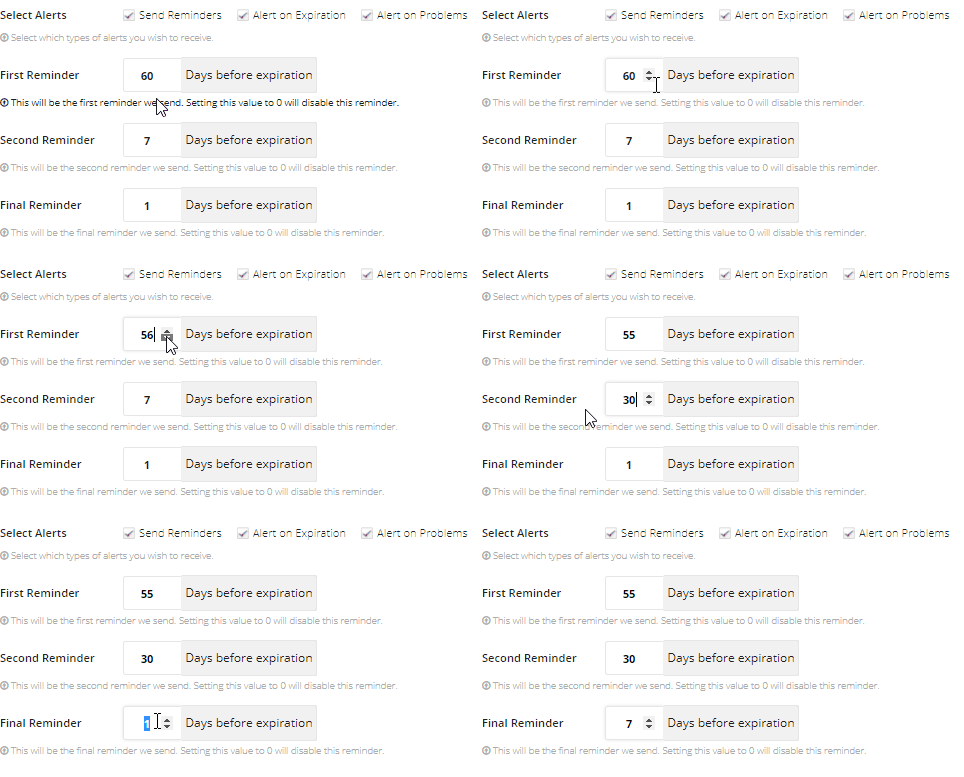
Expiration MonitoringWe’ve fully revamped our expiration monitoring increasing the options in terms of how often the details are checked (anywhere from 5 minutes to 7 days dependent on plan level), also allowing customization of when the alerts for expiry come through – meaning that self-signed certs are now much less troublesome to keep an eye on.

SSL1

Certificate Validity

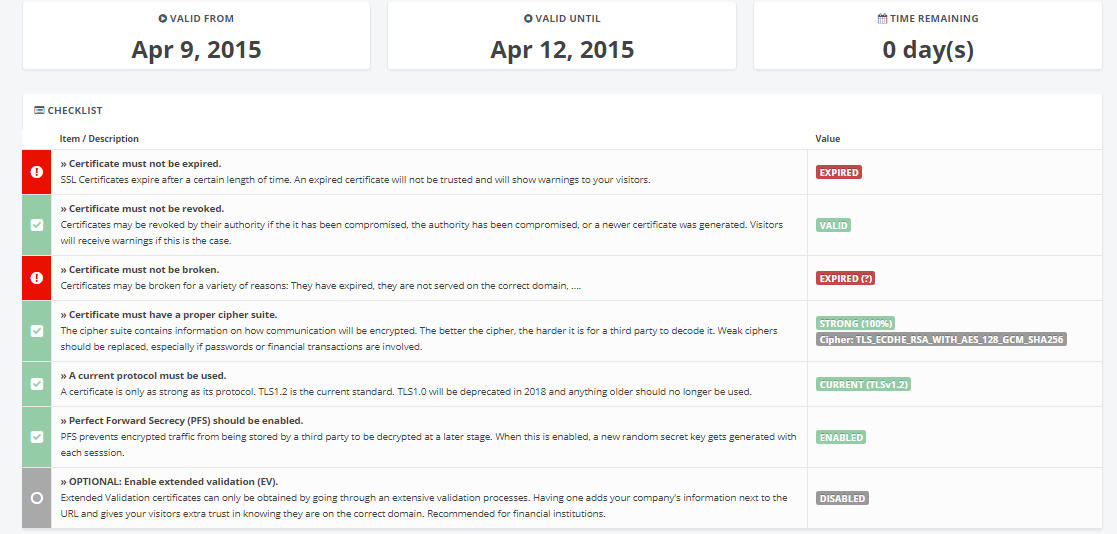
As well as expiry we now watch out for validity issues, we will run a complete check of the certificate chain, verify that the certificate is on the correct domain, and we’ll also ensure that the certificate has not been revoked by the relevant authority. You can get alerted by our system right away if any of these factors are not as they should be.

Certificate Score

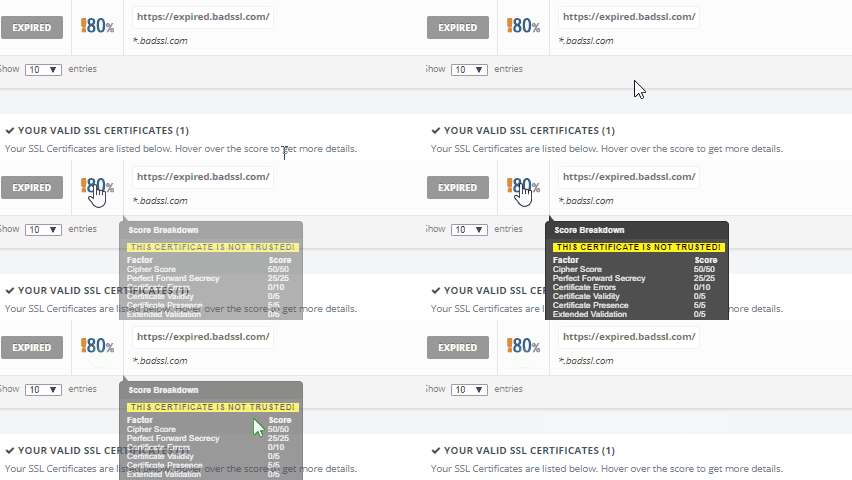
We now take a range of factors into account to provide you with a certificate score. Firstly we look at the “Cipher Strength”. Cipher strength has a proprietary scoring algorithm that takes the following variables into consideration:

SSL2

* Key Exchange

* Bulk Cipher & Strength

* Used Keyed-hash message authentication (HMAC)

From the Cipher Strength and other factors, we give your certificate a final score, the full weightings for this score are shown below:

* Cipher Strength (50%)

* Perfect Forward Secrecy (25%)

* Certificate Errors (10%)

* Certificate Validity (5%)

* Certificate Presence (5%)

* Extended Validation presence (5%)

We will mark your certificate with a score out of 100%, you can see all scores within the SSL section in the left menu. All of the info can also be viewed on the details page, where we provide further data and comparison graphs.

SSL3

The new functionality is available across all paid plans, and all functions are now managed within the SSL section, meaning that there’s increased separation from the uptime tests and the ability to manage these separately.

Share this

More from StatusCake

Engineering

Beyond Uptime: Building a Self-Healing OpenClaw Observability Stack

3 min read The allure of OpenClaw is undeniable. You deploy a highly autonomous, self-hosted AI agent, give it access to your repositories and inboxes, and watch it reason through complex workflows while you sleep. It is the dream of the ultimate 10x developer tool realized. But as any veteran DevOps engineer will tell you: running an LLM-backed

When AWS us-east-1 Fails, Much of the Internet Fails With It

7 min read There are cloud outages, and then there are us-east-1 outages. That distinction matters because failures in AWS’s Northern Virginia region rarely feel like ordinary regional incidents. They tend instead to expose something larger and more uncomfortable: too much of the modern internet still behaves as though one place is an acceptable concentration point for infrastructure,

In the Age of AI, Operational Memory Matters Most During Incidents

7 min read Artificial intelligence is making software easier to produce. That much is already obvious. Code that once took hours to scaffold can now be drafted in minutes. Boilerplate, integration logic, tests, refactors and small internal tools can be generated with startling speed. In some cases, even substantial pieces of implementation can be assembled quickly enough to

AI Didn’t Kill the SDLC. It Made It Harder to See

10 min read Whilst AI has compressed the visible stages of software delivery; requirements, validation, review and release discipline have not disappeared. They have been pushed into automation, runtime and governance. The real risk is not that the lifecycle is dead, but that organisations start acting as if accountability died with it. There is a now-familiar story about

When Code Becomes Cheap: The New Reliability Constraint in Software Engineering

4 min read How AI Is Shifting Software Engineering’s Primary Constraint For most of the history of software engineering, the primary constraint was production. Code was expensive, skilled engineers were scarce, and shipping features required concentrated human effort. Velocity was limited by how fast people could reason, implement, test, and deploy. That constraint shaped everything from team size,

Buy vs Build in the Age of AI (Part 3)

5 min read Autonomous Code, Trust Boundaries, and Why Governance Now Matters More Than Ever In Part 1, we looked at how AI has reduced the cost of building monitoring tools. Then in Part 2, we explored the operational and economic burden of owning them. Now we need to talk about something deeper. Because the real shift isn’t

Want to know how much website downtime costs, and the impact it can have on your business?

Find out everything you need to know in our new uptime monitoring whitepaper 2021

*By providing your email address, you agree to our privacy policy and to receive marketing communications from StatusCake.