





Want to know how much website downtime costs, and the impact it can have on your business?
Find out everything you need to know in our new uptime monitoring whitepaper 2021

If there’s one thing that Google doesn’t want to happen, it’s Google Ads going down and unfortunately for them, that is exactly what happened on March 24th 2021. The worst part is, the outage didn’t merely last a few seconds or minutes, Google Ads was down for hours in Europe.
Being so vast isn’t always a good thing which is exactly what Google learned when not only their Ads platform went down but also their website performance reporting platform, Google Analytics went down too. All across Europe, customers were unable to access their ads, report on their website stats, or see search ads.
As you can imagine, thousands of unhappy people took to Twitter to complain to Google, especially since their ads being down would have a direct impact on their conversions and sales.
The proof? Stretch Digital did the calculations for us and reported that the Google outage would be costing $280,000 per minute in ad revenue. Wow. It’s not a surprising number considering that according to VentureBeat, “Between ads on its own site and ads on its network, Google delivers an astounding 29.8 billion ad impressions every single day”.
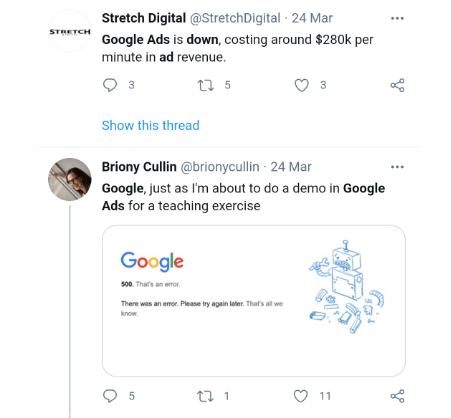

Google wasn’t quick to reply to their customers with answers, mainly it seems because they couldn’t work out what had caused the outage in the first place. Later, they reported that they had experienced a “45-minute outage” because of “an internal storage quota issue”.
Statista reported that in 2020, Google’s ad revenue amounted to 146.92 billion dollars proving it’s a massive revenue-driver for the tech giant. Outages and downtime, however, don’t just affect revenue, they affect customer satisfaction, loyalty, and overall engagement and use of a product or service.
You’ve probably guessed it but the solution really is StatusCake’s uptime monitoring. We alert you as soon as your website goes down in any of your chosen locations so you don’t have to find out through angry customers on Twitter! Take a free trial and see how we can maximise your website performance to ensure you don’t suffer as Google did.

3 min read The allure of OpenClaw is undeniable. You deploy a highly autonomous, self-hosted AI agent, give it access to your repositories and inboxes, and watch it reason through complex workflows while you sleep. It is the dream of the ultimate 10x developer tool realized. But as any veteran DevOps engineer will tell you: running an LLM-backed
7 min read There are cloud outages, and then there are us-east-1 outages. That distinction matters because failures in AWS’s Northern Virginia region rarely feel like ordinary regional incidents. They tend instead to expose something larger and more uncomfortable: too much of the modern internet still behaves as though one place is an acceptable concentration point for infrastructure,
7 min read Artificial intelligence is making software easier to produce. That much is already obvious. Code that once took hours to scaffold can now be drafted in minutes. Boilerplate, integration logic, tests, refactors and small internal tools can be generated with startling speed. In some cases, even substantial pieces of implementation can be assembled quickly enough to
10 min read Whilst AI has compressed the visible stages of software delivery; requirements, validation, review and release discipline have not disappeared. They have been pushed into automation, runtime and governance. The real risk is not that the lifecycle is dead, but that organisations start acting as if accountability died with it. There is a now-familiar story about
4 min read How AI Is Shifting Software Engineering’s Primary Constraint For most of the history of software engineering, the primary constraint was production. Code was expensive, skilled engineers were scarce, and shipping features required concentrated human effort. Velocity was limited by how fast people could reason, implement, test, and deploy. That constraint shaped everything from team size,
5 min read Autonomous Code, Trust Boundaries, and Why Governance Now Matters More Than Ever In Part 1, we looked at how AI has reduced the cost of building monitoring tools. Then in Part 2, we explored the operational and economic burden of owning them. Now we need to talk about something deeper. Because the real shift isn’t