On Wednesday 17th March, globally used DNS provider Network Solutions experienced the dreaded downtime we all hope to avoid. Starting at 4am Eastern time and continuing through to Thursday 18th with still no resolution, it’s affected thousands of people across the world.
Who are Network Solutions?
Network Solutions are the 4th biggest domain registrar in the world, with nearly 7 million users worldwide. They offer a range of different online services, with specialised expertise in domains and web hosting, website optimisations and development, social media advertising, and SSL certificates.
How has Network Solutions downtime affected our customers?
For us, Network Solutions downtime has clearly affected our customers’ website downtime with customers in Canada, the USA, UK, Germany, and France all experiencing DNS type outages.
From our data, it seems that Network Solutions going down has affected people’s emails which will, unfortunately, prove massively detrimental due to the sheer number of emails people are sending now we’re in lockdown due to the Covid-19 pandemic.
On further investigation, we can see that we’ve sent more alerts by both email and SMS than average for website downtime to our user base, with an estimated 1,000 users suffering as a result of Network Solutions being down.
The bad news doesn’t stop there, unfortunately. Network Solutions also has a partner program, meaning that both bigger, well-known companies and smaller businesses will both be affected by this unexplained downtime. Other reported linked providers include register.com.
What are Network Solutions saying about their service issues?
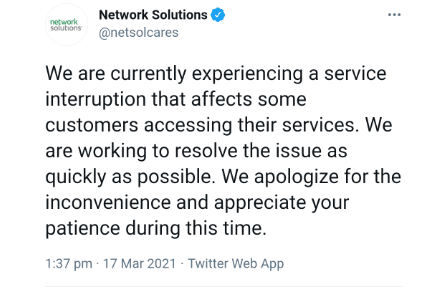
Network Solutions was inundated on Twitter with complaints from users, many wanting to know when it would be back up and running. In a statement from their Twitter profile, they said:
As of 18th March AM, Network Solutions has experienced over 12 hours of service issues, which will undoubtedly have a huge impact on customers worldwide. They’ve had hundreds of comments on social media, more so today with the outage expected to have been fixed ready for their customers today.
It just goes to show that unfortunately, website downtime and outages happen to everyone, regardless of precautionary measures taken. That’s why it’s extremely important to have website monitoring in place to alert you as soon as website downtime happens.
4min read On 13th August 2026, a storm knocked out cooling at RadiusDC’s Phoenix data centre, which hosted essential Namecheap operations. To protect hardware from thermal damage, Namecheap took services offline while temporary chillers were brought in. The incident and recovery ran for roughly 30 hours, with Namecheap’s own site unreachable for about 11 hours 42 minutes
3min read On Wednesday 19 August, Monzo had an outage. DownDetector logged more than 3,000 reports by midday. Monzo’s own statement was direct about what it did next: it activated Monzo Stand-in, its fully independent backup bank, while it investigated an issue affecting customers. By the end of the day, Monzo said the issue was resolved and
3min read GitHub’s incident on 17 August 2026 ran from 13:28 to 21:15 UTC, seven hours and forty-seven minutes. At peak, web and API traffic saw error rates of around 20%, while archive and raw-content downloads reached roughly 50%. SAML and OIDC authentication, SCIM and Team Sync were affected alongside Git operations, Actions, Pages, Issues, Pull Requests
3min read Adding a new website, launching a customer portal, or handing a service to a new team should be straightforward. Setting up monitoring is part of that job, but it is easy for a manual step to be missed when information is spread across several systems. StatusCake now integrates with viaSocket, giving teams a way to connect
7min read A website may be standing and still be in trouble. It may answer a request, return a cheerful 200 OK, and yet load slowly enough that visitors begin to lose patience. Its certificate may be nearing expiry. Its domain records may have changed. A server may be filling its disk in the background, patient and
6min read StatusCake tells you that something might be broken. Hermes can check whether it really looks broken, decide who should hear about it, send the email, and keep the record for tomorrow morning’s summary.
Daniel
May 13, 2026
Sign up for the StatusCake newsletter
Want to know how much website downtime costs, and the impact it can have on your business?
Find out everything you need to know in our new uptime monitoring whitepaper 2021