

Want to know how much website downtime costs, and the impact it can have on your business?
Find out everything you need to know in our new uptime monitoring whitepaper 2021


Today we’ve released a huge update, completely changing how our SSL monitoring works and enabling you to keep a much closer eye on all aspects of your certificates. We’ve introduced a new set of features for SSL, that enable much more powerful monitoring, these are summarized below:
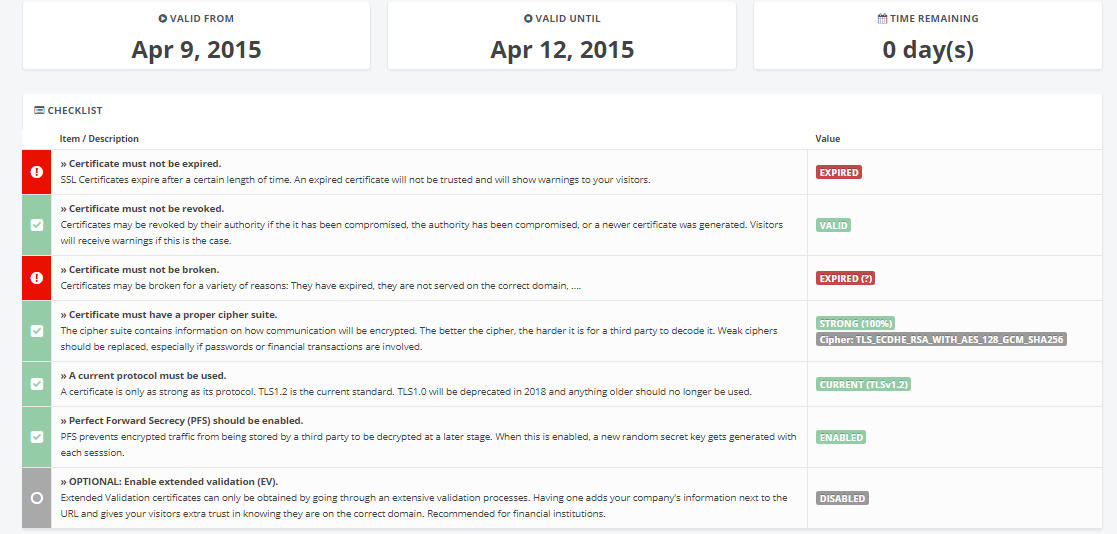
As well as expiry we now watch out for validity issues, we will run a complete check of the certificate chain, verify that the certificate is on the correct domain, and we’ll also ensure that the certificate has not been revoked by the relevant authority. You can get alerted by our system right away if any of these factors are not as they should be.
We now take a range of factors into account to provide you with a certificate score. Firstly we look at the “Cipher Strength”. Cipher strength has a proprietary scoring algorithm that takes the following variables into consideration:
* Key Exchange
* Bulk Cipher & Strength
* Used Keyed-hash message authentication (HMAC)
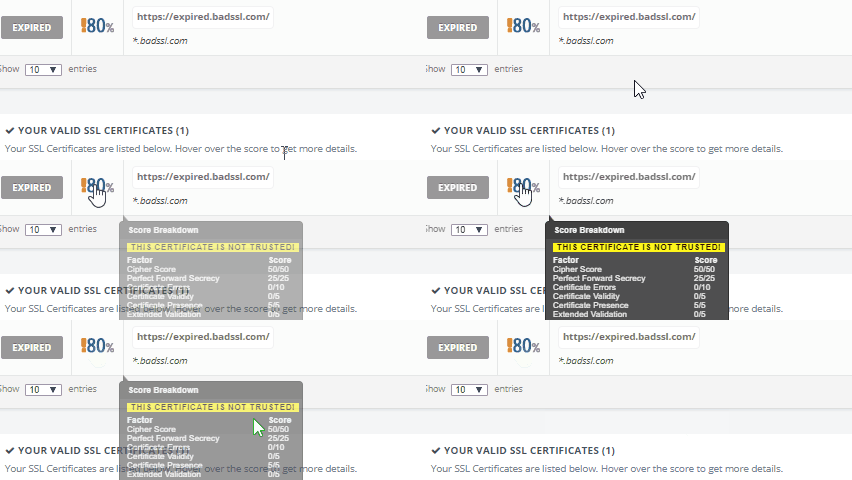
From the Cipher Strength and other factors, we give your certificate a final score, the full weightings for this score are shown below:
* Cipher Strength (50%)
* Perfect Forward Secrecy (25%)
* Certificate Errors (10%)
* Certificate Validity (5%)
* Certificate Presence (5%)
* Extended Validation presence (5%)
We will mark your certificate with a score out of 100%, you can see all scores within the SSL section in the left menu. All of the info can also be viewed on the details page, where we provide further data and comparison graphs.
The new functionality is available across all paid plans, and all functions are now managed within the SSL section, meaning that there’s increased separation from the uptime tests and the ability to manage these separately.
Share this
4 min read In the previous post, we looked at what happens after detection; when incidents stop being purely technical problems and become human ones, with cognitive load as the real constraint. This post assumes that context. The question here is simpler and more practical. What actually helps teams think clearly and act well once things are already
3 min read In the previous post, we explored how AI accelerates delivery and compresses the time between change and user impact. As velocity increases, knowing that something has gone wrong before users do becomes a critical capability. But detection is only the beginning. Once alerts fire and dashboards light up, humans still have to interpret what’s happening,
5 min read In a recent post, I argued that AI doesn’t fix weak engineering processes; rather it amplifies them. Strong review practices, clear ownership, and solid fundamentals still matter just as much when code is AI-assisted as when it’s not. That post sparked a follow-up question in the comments that’s worth sitting with: With AI speeding things
4 min read Why strong reviews, accountability, and monitoring matter more in an AI-assisted world Artificial intelligence has become the latest fault line in software development. For some teams, it’s an obvious productivity multiplier. For others, it’s viewed with suspicion. A source of low-quality code, unreviewable pull requests, and latent production risk. One concern we hear frequently goes

3 min read IPFS is a game-changer for decentralised storage and the future of the web, but it still requires active monitoring to ensure everything runs smoothly.

3 min read For any web developer, DevTools provides an irreplaceable aid to debugging code in all common browsers. Both Safari and Firefox offer great solutions in terms of developer tools, however in this post I will be talking about the highlights of the most recent features in my personal favourite browser for coding, Chrome DevTools. For something
Find out everything you need to know in our new uptime monitoring whitepaper 2021