
StatusCake

Featured Integration: Discord

statuscake

StatusCake alerts.

Today we’d like to take you through one of our newest additions to our integrations for receiving StatusCake alerts. Whilst being a relatively new service, Discord has already made a big impact and already has a user-base of over 90 million individuals worldwide.

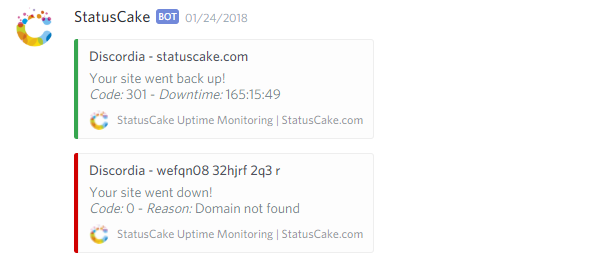
There are some big advantages to using discord as your alerting platform with StatusCake. First of all, it’s very easy to set up the server that will receive the messages in comparison to similar services, it’s a task that can be easily achieved by the most basic users in a very short period of time. What’s more, it’s even easier to set up this integration on our end, all you will need is your “Discord Webhook URL”

Discord is also available across all mobile and desktop platforms, so you can get alerts to your phone and computer no matter which brands or operating systems you go with. As well as that there’s a functional browser version of the app for when you need quick access from an unfamiliar device. There’s support for multiple staff members and the separation/distribution of alerts into different channels within your discord room too – giving you the power to configure this to fit your needs precisely.

discordia

All this is available for free after a simple sign-up over at discordapp.com , once you are done you just need to pop over to our integrations page to start getting the alerts into your own Discord room.

Share this

More from StatusCake

Designing Alerts for Action

3 min read In the first two posts of this series, we explored how alert noise emerges from design decisions, and why notification lists fail to create accountability when responsibility is unclear. There’s a deeper issue underneath both of those problems. Many alerting systems are designed without being clear about the outcome they’re meant to produce. When teams

A Notification List Is Not a Team

3 min read In the previous post, we looked at how alert noise is rarely accidental. It’s usually the result of sensible decisions layered over time, until responsibility becomes diffuse and response slows. One of the most persistent assumptions behind this pattern is simple. If enough people are notified, someone will take responsibility. After more than fourteen years

Alert Noise Isn’t an Accident — It’s a Design Decision

3 min read In a previous post, The Incident Checklist: Reducing Cognitive Load When It Matters Most, we explored how incidents stop being purely technical problems and become human ones. These are moments where decision-making under pressure and cognitive load matter more than perfect root cause analysis. When systems don’t support people clearly in those moments, teams compensate.

The Incident Checklist: Reducing Cognitive Load When It Matters Most

4 min read In the previous post, we looked at what happens after detection; when incidents stop being purely technical problems and become human ones, with cognitive load as the real constraint. This post assumes that context. The question here is simpler and more practical. What actually helps teams think clearly and act well once things are already

When Things Go Wrong, Systems Should Help Humans — Not Fight Them

3 min read In the previous post, we explored how AI accelerates delivery and compresses the time between change and user impact. As velocity increases, knowing that something has gone wrong before users do becomes a critical capability. But detection is only the beginning. Once alerts fire and dashboards light up, humans still have to interpret what’s happening,

When AI Speeds Up Change, Knowing First Becomes the Constraint

5 min read In a recent post, I argued that AI doesn’t fix weak engineering processes; rather it amplifies them. Strong review practices, clear ownership, and solid fundamentals still matter just as much when code is AI-assisted as when it’s not. That post sparked a follow-up question in the comments that’s worth sitting with: With AI speeding things

Want to know how much website downtime costs, and the impact it can have on your business?

Find out everything you need to know in our new uptime monitoring whitepaper 2021

*By providing your email address, you agree to our privacy policy and to receive marketing communications from StatusCake.