Having trained as a lawyer – please don’t hate me! – I’ve been forever told that my emails are too long, and have lost count of the times I’ve been asked if I get paid by the word! And before you ask, the answer is no!
Well those days of Suits are far behind me. But learning how to keep an email or any message short and to the point is incredibly important.
This doesn’t mean I’m advocating we all use text-speak! I’m too old to use text-speak, and it’s by and large completely undecipherable to me. In fact such is the malaise of text-speak that apparently kids in UK schools are already answering exam questions in text-speak. It would seem if this is the case, that the future is truly not bright! If you’re not familiar with text-speak let give you an example from one of England’s best know word-smiths. Any idea what this means?
“2 b, r nt 2 b dat iz d Q wthr ts noblr n d mnd 2 sufr d slngs & arowz of outrAjs fortn r 2 tAk armz agnst a C f trblz, & by oposn nd em?”
I’d actually be more concerned if you did work that out! It’s of course William Shakespeare’s Hamlet; which in its pure form reads:
“To be, or not to be: that is the question. Whether ’tis nobler in the mind to suffer the slings and arrows of outrageous fortune, or to take arms against a sea of troubles. And by opposing end them?”
But having waxed lyrical about brevity I digress. For me Twitter has become a great way to make you think about the message you’re trying to get across. Many of you who have Twitter accounts will know that you have only 140 characters to express yourself. And if you’re looking to provide a link to a story that you’ve seen then you’ll have even less characters in which to make your point.
Combine short, pithy, punchy messages with the huge liquidity of users (some 500+ million) who are accessing Twitter often from their phones, and you have perhaps the best source of real-time information. A true democratisation of information. And although governments the world over have yet to work out how to regulate Twitter (a whole separate debate in itself), whether you’re a consumer trying to ram home a complaint, trying to support a political or ideological belief, or as we saw with the Arab Spring, trying to bring about a real change to your life and society, then Twitter is a powerful and accessible tool.
So here are 10 things you may not have known about the force that is Twitter. And don’t forget you can follow StatusCake on Twitter as well as myself and co-founder Daniel Clarke. If you’ve not got an account, sign-up today and get Tweeting about whatever rocks your boat!
#1 Twitter was born on 21 March 2006
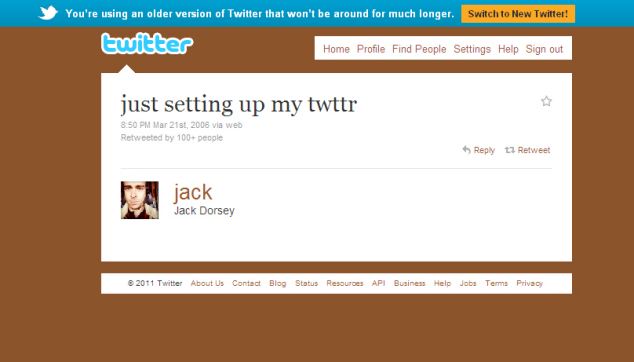
#2 The first Tweet was from Twitter founder Jack Dorsey
#3 500 Million registered users (2012)
#4 340 Million Tweets per Day
#5 The Twitter bird logo – originally called “Larry the Bird” – was named after the Boston Celtic’s NBA player.
#6 40% of Tweets are said to be “senseless babble”
#7 The “fail whale” error message when Twitter is overloaded was designed by Yiying Lu and has its own fan base on Twitter
#8 Ten Most popular Twitter accounts:
1. Justin Bieber (35,404,331)
2. Lady Gaga (34,707,918)
3. Katy Perry (33,067,181)
4. Rihanna (28,607,903)
5. Barack Obama (27,888,669) –
6. Taylor Swift (24,613,447)
7. Britney Spears (24,405,777)
8. YouTube (24,203,092)
9. Shakira (19,924,329)
10. Kim Kardashian (17,457,014)
No one at StatusCake follows any of these accounts!
#9 A record 24.1 million tweets were sent on the night of the Super Bowl XLVII on February 2013
#10 If you follow @StatusCakeTeam it makes us smile all day long!
4min read On 13th August 2026, a storm knocked out cooling at RadiusDC’s Phoenix data centre, which hosted essential Namecheap operations. To protect hardware from thermal damage, Namecheap took services offline while temporary chillers were brought in. The incident and recovery ran for roughly 30 hours, with Namecheap’s own site unreachable for about 11 hours 42 minutes
3min read On Wednesday 19 August, Monzo had an outage. DownDetector logged more than 3,000 reports by midday. Monzo’s own statement was direct about what it did next: it activated Monzo Stand-in, its fully independent backup bank, while it investigated an issue affecting customers. By the end of the day, Monzo said the issue was resolved and
3min read GitHub’s incident on 17 August 2026 ran from 13:28 to 21:15 UTC, seven hours and forty-seven minutes. At peak, web and API traffic saw error rates of around 20%, while archive and raw-content downloads reached roughly 50%. SAML and OIDC authentication, SCIM and Team Sync were affected alongside Git operations, Actions, Pages, Issues, Pull Requests
3min read Adding a new website, launching a customer portal, or handing a service to a new team should be straightforward. Setting up monitoring is part of that job, but it is easy for a manual step to be missed when information is spread across several systems. StatusCake now integrates with viaSocket, giving teams a way to connect
7min read A website may be standing and still be in trouble. It may answer a request, return a cheerful 200 OK, and yet load slowly enough that visitors begin to lose patience. Its certificate may be nearing expiry. Its domain records may have changed. A server may be filling its disk in the background, patient and
6min read StatusCake tells you that something might be broken. Hermes can check whether it really looks broken, decide who should hear about it, send the email, and keep the record for tomorrow morning’s summary.
Daniel
May 13, 2026
Sign up for the StatusCake newsletter
Want to know how much website downtime costs, and the impact it can have on your business?
Find out everything you need to know in our new uptime monitoring whitepaper 2021