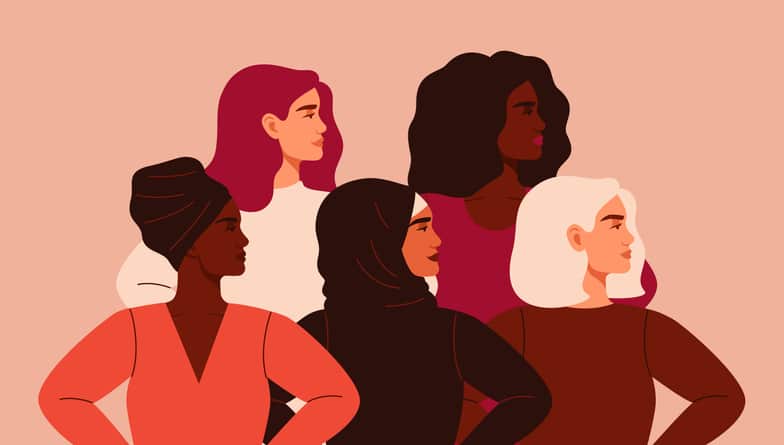
March 8th marks International Women’s Day – a day where we celebrate all womankind and everything that they give to the world. Though women have struggled through many hardships and arguably, still do, we have maintained our strength, our dignity, and our plight to continuously try to make the world a better place. From the suffragettes risking their livelihoods for our right to vote to the recent implementation of tax-free sanitary products, we have made leaps and bounds for women’s rights but we still have so much further to go.
All across the world, women’s rights are terribly violated, especially in poorer countries where girls still aren’t able to go to school and get an education. That’s why it’s even more important than ever to continuously uplift women and fight for those that can’t fight for themselves. It’s also important that we have a voice and share our experiences and celebrate those who have helped to change the world for good to inspire other women to do the same.
That’s why I’ve written this blog post. Not to discuss with you the suffering of women, but to showcase the aspirational achievements that women throughout history have made that have changed the way we do things today. Join me on a voyage through the years as we see what women in tech can do when they’re empowered and free.
Ada Lovelace – The automatic digital computer
You’ve probably heard the name “Charles Babbage” in relation to the invention of the digital computer, but many less of you have probably heard of English mathematician and engineer, Ada Lovelace. Ada worked with Charles to help create “the Analytical Engine” known as the first automated, digital computer, with Charles working as her mentor during the creation.
Ada is credited with being “the first computer programmer” the world has ever seen, having been able to write, what we now refer to as “code”, to make a computer function. She discussed at length the concept of coding symbols and letters, building algorithms, and enabling computers to follow “instructions” automatically which paved the way for the evolution of computers that followed and ultimately, how we use computers today.
Daughter of the world-famous poet, Lord Byron, Ada was an avid writer but not in the way that her father was – she wrote about computer engineering. In 1843, Ada was published as an author in an English Science journal with her essay on the Analytical Machine which only became popular after her death.
Joan Clarke – Code breaker of the Enigma Code
Much like Ada Lovelace and Charles Babbage, Joan Clarke seems to always be a second thought to Alan Turing when it comes to the breaking of the Enigma Code back in World War Two. Unbeknownst to some, Joan worked alongside Turing at Bletchley Park and was fundamental in the cracking of the code.
The Enigma Code was known as an “unbreakable code” to most, especially since both Germany and England knew that if England could decipher it, they would have a tremendous upper hand in the war effort. Many people had attempted to break the code before Turing and Clark but with little or no luck, leading the government to scour the country to find the leading mathematicians and cryptanalysts. Enter Joan Clarke.
Joan Clarke worked tirelessly with Turing and their team to decode the Enigma, using the Banburismus technique to try to break it quicker. Clarke used this, alongside a WW1 technique called Dillysimus, and eventually, their team managed to crack the uncrackable. Her efforts undoubtedly counted towards England’s victory in WW2 and because of this, she was awarded an MBE in 1947.
Marie Curie – Radioactivity
Most of you will know who Marie Curie is but to celebrate International Women’s Day without mentioning her is almost unthinkable. Marie Curie is one of the most influential women in history due to her work on radioactivity and the discovery of radium and polonium. She managed to find a way to measure radioactivity which has paved the way for how we understand and use radioactivity in the modern-day. Think of when you go for an X-ray at a hospital, extra precautions are taken because people now know the effects of harmful radiation.
During her lifetime, Marie Curie was the first ever woman to win a Nobel Prize and is still the only woman to have won two in two different areas of study.
Her work during WW1 was also hugely influential, as she took mobile X-ray machines to help soldiers on the front line who had been impacted with shrapnel and debris.
Sadly, due to her work with radiation, Marie developed Leukaemia and died in 1934. A charity was named in her honour which helps terminally ill people find comfort in the later stages of their life and funds research into developing cancer treatments today.
Radia Perlman – The internet
For developers, Radia Perlman is dubbed “the mother of the internet” due to her being behind the “STP” of the internet’s foundation. She managed to use an algorithm to generate the STP which made the internet what it is today. Many people, however, have still not heard of Radia, especially since Tim Berners-Lee is the most widely-accredited internet maker for creating the World Wide Web.
Unlike the other influential women that feature in this blog, Radia is still alive today living in Portsmouth, Virginia. Her career as a computer programmer and network engineer has undoubtedly shaped the internet as we know it, allowing us to “surf the web” without a second thought, even though she only started working on it in the 1970s. Radia’s work focused on network routing enabling the internet to become vast and scalable and has since designed TRILL which focuses on internet bandwidth.
Katherine G. Johnson – Aerospace technology
Katherine G. Johnson had a career spanning 35 years at the world-famous space agency, NASA, and helped work on projects that saw the landing on the moon, the first flight into space, and the mission to Mars project. Katherine worked on calculating and formulating the technological plans for the projects and ultimately had the astronauts’ lives in her hands.
She has been an advocate for African-American women in the aerospace technology arena and has even had a film, “Hidden Figures”, depicted about her time as one of the few African-America females at NASA and how she pushed for change.
This made Katherine one of the most influential women in history, and especially at NASA during her career, making waves in the company during the 1950s when race and gender issues were rife in workplaces, especially across America.
Her achievements haven’t stopped there, since leaving NASA, Katherine has been awarded the Medal of Freedom for her contributions to society which has inspired women of all races across the globe.
These are just a few of the many thousands of women that have played an influential role in the history of technology, some we probably will never even know about. On this International Women’s Day, we want to celebrate each and every woman, not only in the tech industry but in every industry, in every part of the world. Let’s continue to diversify our workplaces. I hope we continue to achieve great things. I hope we push harder, find the equality we so desperately seek, and uplift each and every woman that we come into contact with.
Have a great day.