


Want to know how much website downtime costs, and the impact it can have on your business?
Find out everything you need to know in our new uptime monitoring whitepaper 2021


Today we’d like to introduce two great new features available on the StatusCake monitoring platform, we’ve received a lot of requests recently for the new functionality these will offer. You can read more about exactly what the new additions enable you to do below!
Our new basic test editor allows you to set up HTTP type tests much faster than you’d usually be able to using our standard test creation form. When creating a basic test you will only need to select the URL to be tested, check rate, and testing location, you can also optionally assign contact groups and tags.
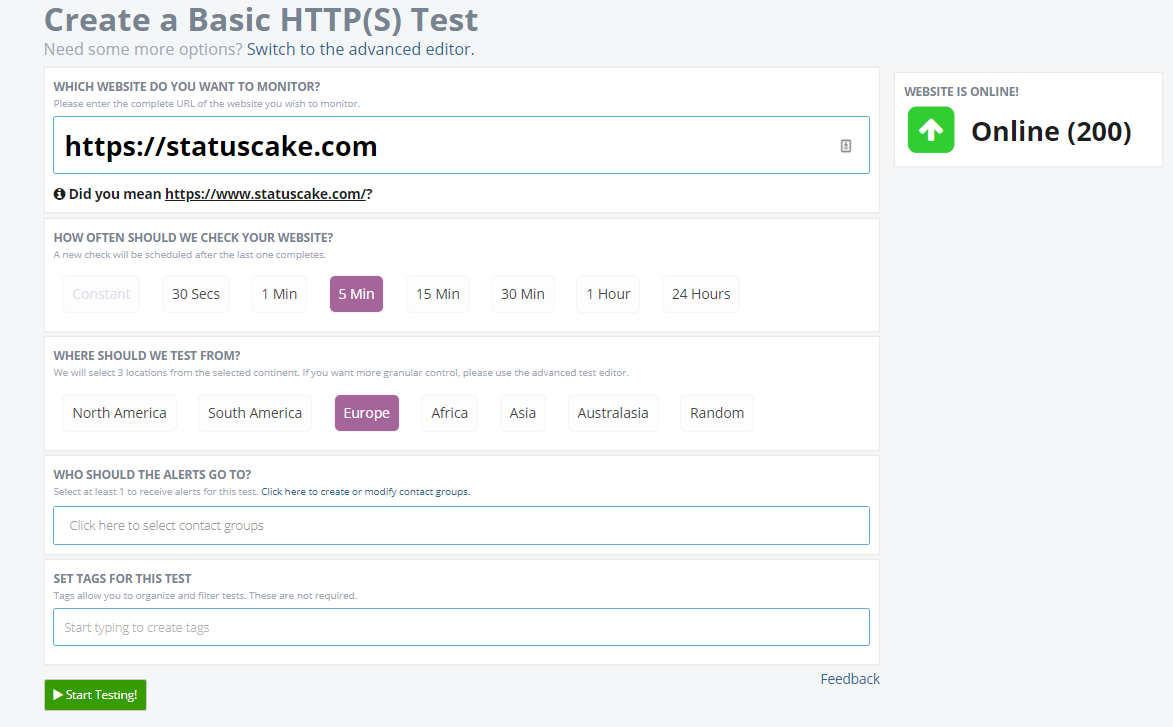
From the dashboard you can now use the basic test editor at any time using the new buttons at the top, you’ll also have the option to create an “Advanced test” using our standard form, which will allow you to access the more complex configurations such as string match, custom headers, and POST data. When creating a basic test you can switch to the advanced setup form at any time by clicking the link at the very top of the form.

When using the basic test editor you will be given the status of the website after typing the URL in a box to the left of the page, so you can be sure that the settings you have added are correct before saving. We’ve also simplified the location selection part, you now have the ability to select a continent from where you would like testing to occur, and locations will be assigned from that continent only. There’s the option as well to select “Random” and have the tests come from our locations around the globe with no restrictions.
We’ve added the ability to export your test settings as a CSV file from the main uptime test dashboard. At the top of the page, you’ll now see a button labelled “Export Settings” which can be clicked to action the download for all tests straight away.

The file downloaded will have semi-colon separated values, for a full reference of the details that the file will contain please check here.
Share this
6 min read The Real Cost of Owning Monitoring Isn’t Code — It’s Everything Else In Part 1, we explored how AI has dramatically reduced the cost of building monitoring tooling. That much is clear. You can scaffold uptime checks quickly, generate alert logic in minutes, and set-up dashboards faster than most teams used to schedule the kickoff
5 min read AI Has Made Building Monitoring Easy. It Hasn’t Made Owning It Any Easier. A few months ago, I spoke to an engineering manager who proudly told me they had rebuilt their monitoring stack over a long weekend. They’d used AI to scaffold synthetic checks. They’d generated alert logic with dynamic thresholds. They’d then wired everything
3 min read In the previous posts, we’ve looked at how alert noise emerges from design decisions, why notification lists fail to create accountability, and why alerts only work when they’re designed around a clear outcome. Taken together, these ideas point to a broader conclusion. That alerting is not just a technical system, it’s a socio-technical one. Alerting
3 min read In the first two posts of this series, we explored how alert noise emerges from design decisions, and why notification lists fail to create accountability when responsibility is unclear. There’s a deeper issue underneath both of those problems. Many alerting systems are designed without being clear about the outcome they’re meant to produce. When teams
3 min read In the previous post, we looked at how alert noise is rarely accidental. It’s usually the result of sensible decisions layered over time, until responsibility becomes diffuse and response slows. One of the most persistent assumptions behind this pattern is simple. If enough people are notified, someone will take responsibility. After more than fourteen years
3 min read In a previous post, The Incident Checklist: Reducing Cognitive Load When It Matters Most, we explored how incidents stop being purely technical problems and become human ones. These are moments where decision-making under pressure and cognitive load matter more than perfect root cause analysis. When systems don’t support people clearly in those moments, teams compensate.
Find out everything you need to know in our new uptime monitoring whitepaper 2021