

Want to know how much website downtime costs, and the impact it can have on your business?
Find out everything you need to know in our new uptime monitoring whitepaper 2021


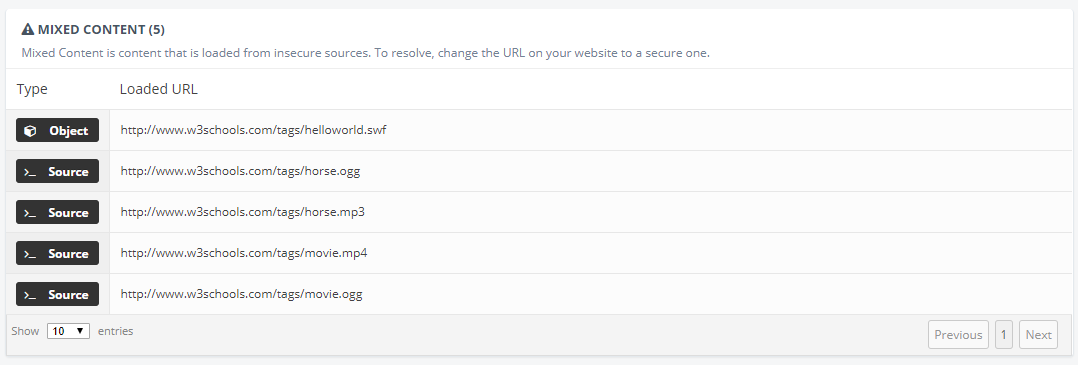
Mixed content occurs when the site is accessed over a HTTPS secure connection, but other resources on the page are loaded through an insecure connection. This is defined as “Mixed Content” as both HTTP and HTTPS content are being loaded on the same page when the request started as a secure HTTPS request.
In most cases, users will receive a warning from their browser to indicate that this is the case when visiting the site.
To protect the integrity, security, and secrecy of your data where necessary. It’s required that all resources be served over a HTTPS connection. If there’s a single resource on any given page that’s not secured in this way then your users will be informed that the page is not fully secure upon visiting.
Having a fully secured page will assure your users of the following facts:
With StatusCake you can now ensure that none of your pages contain Mixed Content, we’ve built this functionality into our SSL monitoring feature, so you can now be alerted the moment anything of this nature is found.
It’s important to note that mixed content will only be detected by us on the page you are testing, so a test on your homepage’s URL for SSL will not detect mixed content on other pages of the website. If you want to test more than one page then multiple tests would be required. Also worth remembering is that resources requested from scripts or within iframes will not be checked.
The option is enabled by default for all SSL testing as it’s an essential thing to watch out for – and alerting will fire automatically for any SSL tests that currently have a contact group. If you do not have a contact group attached to your SSL test it’s just a case of adding one and then entering the settings to select the “Mixed Content” check box.
For information on how to use the feature please check out our Knowledgebase article here.
Share this

3 min read The allure of OpenClaw is undeniable. You deploy a highly autonomous, self-hosted AI agent, give it access to your repositories and inboxes, and watch it reason through complex workflows while you sleep. It is the dream of the ultimate 10x developer tool realized. But as any veteran DevOps engineer will tell you: running an LLM-backed
7 min read There are cloud outages, and then there are us-east-1 outages. That distinction matters because failures in AWS’s Northern Virginia region rarely feel like ordinary regional incidents. They tend instead to expose something larger and more uncomfortable: too much of the modern internet still behaves as though one place is an acceptable concentration point for infrastructure,
7 min read Artificial intelligence is making software easier to produce. That much is already obvious. Code that once took hours to scaffold can now be drafted in minutes. Boilerplate, integration logic, tests, refactors and small internal tools can be generated with startling speed. In some cases, even substantial pieces of implementation can be assembled quickly enough to
10 min read Whilst AI has compressed the visible stages of software delivery; requirements, validation, review and release discipline have not disappeared. They have been pushed into automation, runtime and governance. The real risk is not that the lifecycle is dead, but that organisations start acting as if accountability died with it. There is a now-familiar story about
4 min read How AI Is Shifting Software Engineering’s Primary Constraint For most of the history of software engineering, the primary constraint was production. Code was expensive, skilled engineers were scarce, and shipping features required concentrated human effort. Velocity was limited by how fast people could reason, implement, test, and deploy. That constraint shaped everything from team size,
5 min read Autonomous Code, Trust Boundaries, and Why Governance Now Matters More Than Ever In Part 1, we looked at how AI has reduced the cost of building monitoring tools. Then in Part 2, we explored the operational and economic burden of owning them. Now we need to talk about something deeper. Because the real shift isn’t
Find out everything you need to know in our new uptime monitoring whitepaper 2021